Why Isn't My PCR Working? Troubleshooting Guide
7 min read · Updated September 24, 2026
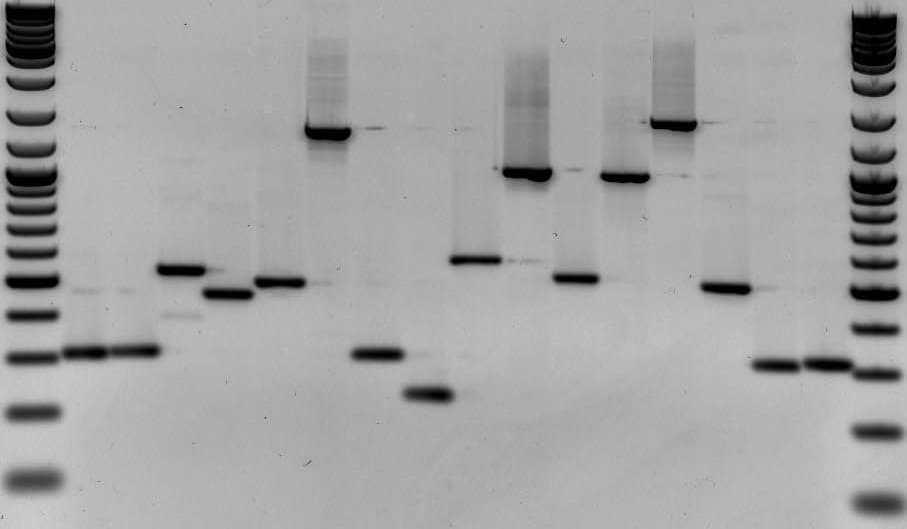
A PCR that comes back empty, shows the wrong band, or smears across the gel almost always has a specific, findable cause — it just isn't always the cause you assume first. This guide works through the four ways a PCR reaction actually fails, in roughly the order they turn out to be the real problem, and gives a concrete fix for each. It ends with the on-paper checks worth doing before you touch the bench again.
No product at all
An empty lane has the longest list of possible causes, but they aren't equally likely. Work down this list roughly in order:
- Annealing temperature set too high relative to the primers' actual Tm. This is the most common reason a PCR produces nothing at all, and it's easy to miss because the annealing temperature often gets carried over from a different primer pair or a generic default rather than calculated from the primers in the tube. Check both primers' Tm and set the annealing temperature a few degrees below the lower of the two, not a round number that sounds reasonable.
- The primer pair doesn't actually bind the intended template. A primer can look correct on paper — right length, reasonable GC%, clean Tm — and still have been designed against the wrong reference sequence, an outdated build, or a template with a typo or an unannotated variant at the binding site. Running an in silico PCR check against the real template you're amplifying catches this immediately, because it either predicts a product where you expect one or it doesn't.
- A primer has a strongly stable hairpin or self-dimer. When a primer's own secondary-structure free energy (ΔG) is very negative, it folds on itself or binds another copy of itself more readily than it binds the template, and the reaction never gets going. Checking secondary-structure ΔG using nearest-neighbor thermodynamics catches this before you order the primer; the nearest-neighbor Tm guide covers the calculation and the ΔG thresholds in detail.
- Template quality or quantity. Degraded template, template that's too dilute, or carryover of extraction inhibitors (residual salts, phenol, ethanol) can all suppress amplification even with well-designed primers. This is worth checking, but it's usually further down the list than people assume — most no-product reactions trace back to the primers, not the template.
Multiple bands, or a band at the wrong size
This almost always means the primer pair binds more than one site in the template or genome, not that something is contaminated. An in silico PCR check against the full template or genome reports every predicted product and exactly where each one falls, which turns a vague extra band into a specific, known second binding site rather than a mystery. Once you know where the alternate site is, the fix is usually one of two things: redesign the primer that's binding both sites so it's specific to the intended one, or, if the alternate site is a weaker match, raise the annealing stringency so only the intended, better-matched site anneals efficiently.
In silico PCR runs forwards from the primers. When you already have the band and its size, work backwards instead: Band Traceback searches both primers against both strands of your template, allowing the mismatches you set, keeps only the pairs of priming sites that would give a product of the size you measured — including one primer priming both ends — and ranks them by how much of each primer's 3' end matches, because an interrupted 3' terminus is what stops a mispriming event. If nothing on the template fits, that points away from the template altogether: a primer-dimer, carry-over of another plasmid or genomic DNA, or a size read further off than you allowed.
A small, fuzzy band under about 60 bp, especially if it's also in the no-template control
This is the classic primer-dimer signature, and the no-template control is what confirms it: a dimer needs only the two primers, not template, so if the small band shows up in a reaction with no template added, it isn't an amplification artifact of your sample. The primer-dimer guide covers the full mechanism, including why the 3' end matters most and the ΔG thresholds that predict it, so it's worth reading in full rather than re-deriving here. In practice, the fix is to redesign the primers' 3' ends to remove complementarity between the pair. Short term, before a redesign, raising the annealing temperature and lowering primer concentration usually suppresses the dimer enough to get a usable reaction.
Smeared or generally nonspecific product across a range of sizes
A smear rather than a discrete band or two points to a lack of priming specificity across the whole reaction, and it usually has one of two causes. The first is an annealing temperature set too low relative to the primers' real Tm, which gives every partial-match site in the template a chance to prime alongside the intended one — the fix is the same check as for no product at all: confirm both primers' actual Tm and anneal a few degrees below the lower value, this time raising rather than lowering the temperature you're using. The second is degraded or impure template, which introduces enough spurious sequence or nicked strands to create priming sites that shouldn't exist; cleaning up or re-extracting the template is the fix here, not adjusting the primers.
Check the primers on paper before you change anything at the bench
Before reaching for a new annealing temperature, a different master mix, or more cycles, it's worth re-checking three things about the primers themselves, because a large share of "my PCR isn't working" cases trace back to a primer design issue that no amount of bench-side troubleshooting will fix:
- Tm match between the forward and reverse primer, and whether your annealing temperature is actually set relative to the lower of the two.
- Specificity against the real template or genome you're amplifying, not just the sequence you think you designed against.
- Secondary-structure ΔG for hairpins and self-dimers, and cross-dimer ΔG between the pair.
Running these checks with SeqBench
Primer Designer generates ranked candidate primer pairs directly from a template, with Tm, GC content and dimer checks already applied, so a new pair starts from a position where the most common failure causes above have already been screened out. If you already have a primer pair in hand and want to confirm it before ordering or re-running it, In-silico PCR checks it against the actual template and reports every predicted product, its size, and its position — a direct check on the "multiple bands" and wrong-template causes above. Oligo Analyzer runs the nearest-neighbor Tm and ΔG calculation on an existing primer or pair, flagging hairpins and primer dimers so you know the annealing temperature and secondary-structure risk before you go back to the bench.
One thing to be clear about, because this article is prose and the product is code: the ordered list above is a hand-written checklist, not the authoritative cause list. The authoritative one lives in the Cloning Troubleshooter's engine (the cloning_diagnose tool), which carries the same four candidates for an empty lane as named functions — annealing_too_high, no_priming_site, primer_dimer and reaction_or_template_missing — and decides each from YOUR primers, template and controls rather than from a general ordering. It also does the thing an article cannot: it reports which causes your controls have already eliminated, and names the observation that did it. Read this page for why each cause behaves as it does; run that tool to find out which one you are in. Where the two disagree, the engine is what ships and this page is what needs correcting.
Frequently asked questions
Why is my PCR not working even though the primers look fine?
Looks fine usually means the length, GC% and rough Tm are reasonable, but that does not confirm the annealing temperature matches the primers' actual Tm or that the pair is specific to the real template. Checking both primers' Tm and running an in silico PCR check against the actual template catches most of what a visual check misses.
Why does my PCR give multiple bands or a band at the wrong size?
This almost always means the primer pair binds more than one site in the template or genome. An in silico PCR check reports every predicted product and its position, so you can see the second binding site directly instead of guessing from the gel.
How do I know if a small band is a primer dimer and not my real product?
Check whether the small band, usually under about 60 bp, also appears in the no-template control. A dimer only needs the two primers, not template, so if it is there without any template added, it is a primer dimer rather than a nonspecific amplification of your sample.
Why does my PCR produce a smear instead of a clean band?
A smear across a range of sizes usually means the annealing temperature is too low relative to the primers' real Tm, letting many partial-match sites prime alongside the intended one, or that the template is degraded or impure enough to introduce spurious priming sites.
Related references
Related tools
Design ranked PCR primer pairs from a template, with Tm, GC and dimer checks.
Enter a template and two primers to predict the PCR product, its size and position.
Work backwards from the size you measured: which pairs of priming sites on your template could make a product that big, and can their 3' ends actually extend?
Nearest-neighbor Tm, ΔG, hairpins and primer dimers for any oligo or primer pair.
No colonies, every clone empty vector, or no PCR band: get the causes your design and your control plates actually implicate, and the cheapest experiment that separates the top two.